

Trust is Time - And Time is Money
Why the Most Overlooked Driver of Organizational Efficiency Is Relational, Not Operational
Trust is often misunderstood.
While it makes sense that trust improves our experience, it is less obvious how much time and energy it saves. Low trust creates friction. Friction slows decisions, duplicates effort, and turns small problems into expensive ones. High trust does the opposite. It accelerates everything it touches. And in organizations under fiscal pressure, that acceleration is not a nice-to-have. It is an operational advantage.
April 1st, 2026 - Waterloo, Ontario
Most conversations about efficiency in organizations focus on process. Streamline workflows. Reduce redundancies. Automate where possible. Restructure reporting lines. These are reasonable interventions, and sometimes necessary.
But they miss something fundamental.
“The single biggest source of wasted time in most organizations is not inefficient process. It is low trust.”
When trust is low, everything takes longer. Decisions that should be straightforward require extra meetings, extra approvals, extra reassurance. Information moves slowly because people are unsure who to share it with, or whether sharing it will be held against them. Conflicts that could be resolved in a single honest conversation instead simmer for weeks, consuming attention and energy before eventually escalating into formal processes.
When trust is high, the opposite happens. Decisions move faster because people trust the judgment of their colleagues. Information flows freely because sharing it feels safe. Problems get raised early, when they are small and inexpensive to fix, rather than late, when they have become costly and entrenched.
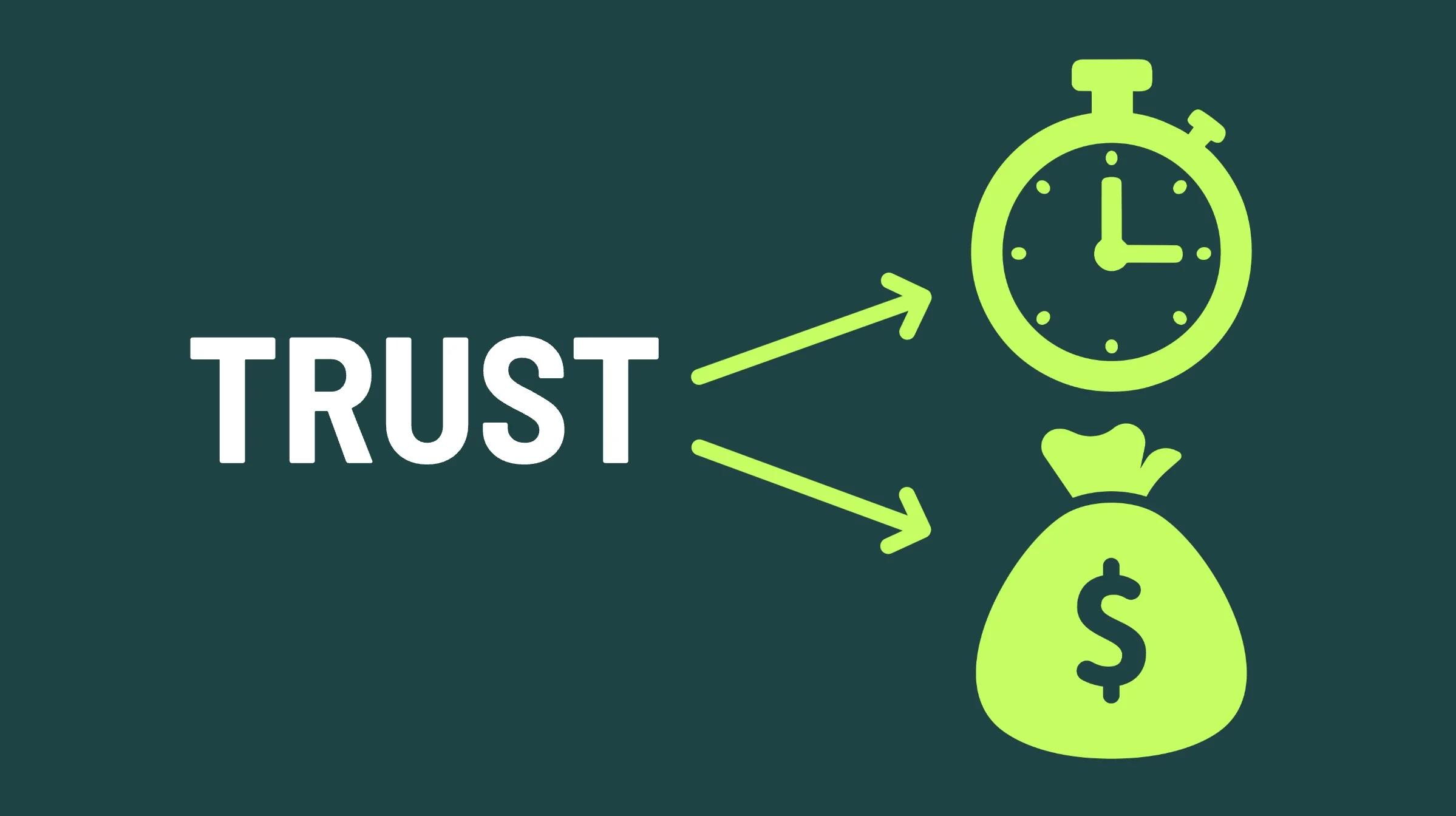
This is not a soft argument. It is an operational one. As Stephen M.R. Covey put it in The Speed of Trust: trust always affects two measurable outcomes. Speed and cost. Higher trust, higher speed, lower cost. The relationship is that direct.
The Hidden Cost Structure of Low Trust
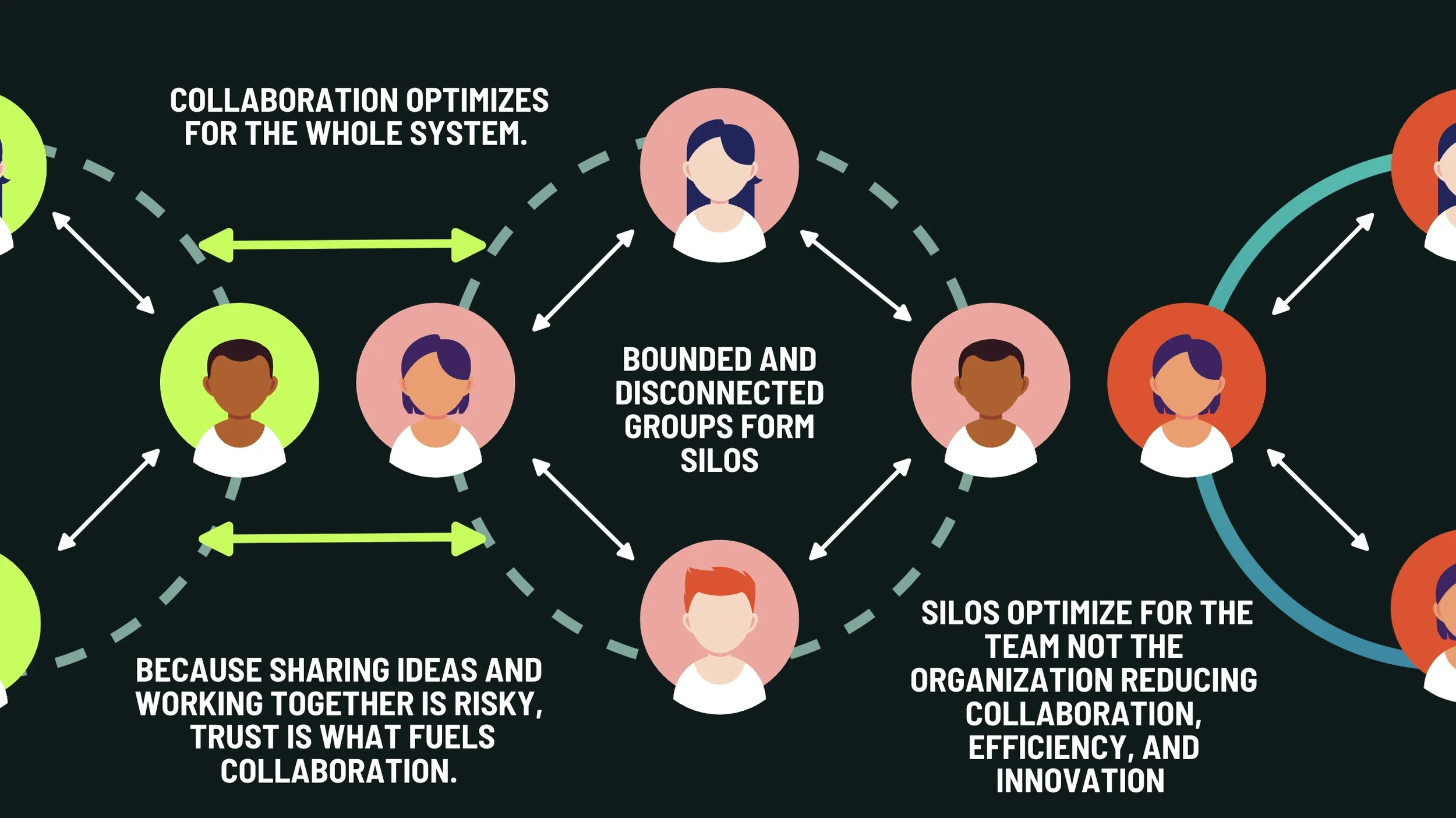
Silos Optimize for the Wrong Thing
Every organization wants collaboration. Most have the talent for it. What's missing is the relational trust between teams that makes it feel safe enough to try.
Fix the trust gap. The silo largely takes care of itself.
Low trust creates friction. Friction creates drag. Drag costs time. And in any organization, especially those under fiscal pressure, time is the resource leaders can least afford to waste.
Consider what low trust actually looks like in practice.
A supervisor who does not trust their team checks and rechecks work before it goes forward. That is duplication. A team that does not trust the team next to them builds their own workaround rather than collaborating. That is a silo. A manager who does not trust that candour is safe delivers vague feedback that never corrects the real issue. That is rework, repeated across months.
None of these behaviours show up in a budget line. But they consume hours, weeks, and in some cases entire positions worth of capacity that could be directed toward the mission the organization actually exists to serve.
When we talk about operational efficiency, we tend to look at systems and structures. But systems and structures are operated by people. And how those people relate to one another, whether they trust each other enough to move quickly, share honestly, and resolve friction early, determines how much of the organization's capacity is spent on the work itself versus managing the consequences of low trust.
This argument has formal support. Chami and Fullenkamp (2002), writing in the Journal of Banking and Finance, modeled trust as mutual altruism between coworkers and found that trusting firms spend less effort monitoring each other and more effort on actual work. Their conclusion was direct: trust is a more cost-effective solution to coordination problems than surveillance or performance pay, and it produces measurably better outcomes. The inefficiencies of low-trust environments, they argued, are not soft cultural concerns. They are structural drags on productivity.
The numbers from organizational research confirm the scale of the gap. Neuroscientist Paul Zak's research, published in the Harvard Business Review, found that compared with people at low-trust companies, people at high-trust organizations report 50% higher productivity, 106% more energy at work, 76% more engagement, and 40% less burnout. These are not marginal differences. They represent a substantial portion of an organization's available capacity, either accessible or locked away depending on the trust conditions the leader creates.
Two Types of Trust, Two Types of Efficiency
Not all trust works the same way. Understanding the distinction matters for leaders trying to improve both efficiency and experience.
Transactional trust is built on ability and track record. Can you do the job? Have you delivered before? This type of trust supports routine, predictable, repeatable work. It is the foundation of reliable execution. When transactional trust is strong, teams can move quickly on familiar tasks because everyone knows their role and trusts that others will fulfil theirs.
Relational trust adds a third element: care. Do you care about me, about this work, about what happens to our team? Relational trust enables something different. It supports collaboration under uncertainty, hard conversations, creative problem-solving, and the willingness to take risks that are necessary when the path forward is unfamiliar.
Most efficiency efforts focus on the transactional layer. Clearer roles, better processes, tighter accountability. These are valuable. But they only unlock efficiency in the domain of doing more of what is already working.
When organizations need to do something different, when they are navigating change, fiscal pressure, restructuring, or new strategic priorities, relational trust is what allows people to move together rather than retreat into protective silos.
The efficiency gain from relational trust is harder to measure but often more significant. It shows up as the meeting that did not need to happen because two people resolved the issue directly. The project that stayed on track because someone raised a concern early instead of waiting for it to become a crisis. The decision that moved forward because the team trusted the leader's judgment and did not need to relitigate every detail.
These are not small savings. Across an organization, they compound.
Arrow (1975) put this plainly: much of the economic underperformance in the world can be traced not to a lack of technology or resources, but to a lack of mutual confidence. The same logic applies inside organizations.

Why This Matters Now for Municipal Leaders
Municipal governments across Canada are under exceptional fiscal pressure. Budgets are constrained. Costs are rising from inflation, supply chain disruption, and the downstream effects of trade uncertainty. At the same time, expectations for service delivery are not decreasing. If anything, they are increasing.
The conventional response to fiscal pressure is to look for places to cut. Reduce headcount. Defer projects. Consolidate services. These may be necessary in some cases. But they carry their own costs, particularly to the trust and morale of the people being asked to deliver the same outcomes with fewer resources.
There is a complementary path that is often overlooked.
It is also worth noting what municipal governments already hold. A nationwide poll conducted by Abacus Data found that 61% of Canadians trust their municipal government to best understand the challenges facing their communities, more than any other order of government. That is a significant asset. Internal trust is what determines whether an organization can deliver on the confidence the public has placed in it. When internal trust erodes, the organization's ability to respond effectively erodes with it, quietly and often invisibly until the gap becomes visible in service delivery.
Investing in trust does not require large budgets. It requires intentionality. When leaders build shared language around trust, when they learn to distinguish between transactional and relational trust and apply each appropriately, when they create conditions where feedback moves faster and friction resolves earlier, the result is not just a better employee experience. It is a faster, leaner, more responsive organization.
Trust is the mechanism that converts individual effort into collective capacity. Without it, talented people work hard in parallel without producing the results their combined ability should deliver. With it, organizations punch above their weight. They move faster. They waste less. They adapt more readily.
For municipal leaders navigating the current fiscal landscape, the question is not whether you can afford to invest in trust. It is whether you can afford not to.
What Leaders Can Do
Building trust is not a program. It is a practice. And like most practices, it begins with small, consistent actions rather than sweeping initiatives.
Start by noticing where friction is quietly consuming time. Look for the meetings that exist because two departments do not communicate directly. Look for the decisions that stall because no one is sure who has authority. Look for the patterns where problems get escalated rather than resolved at the level where they occur.
These are trust problems in operational clothing.
Then invest in the conditions that allow trust to build. Give people shared language for how trust works and what erodes it. Create space for honest conversation that is not mediated by formal process. Recognize and reinforce the everyday behaviours, the careful and caring choices, that accumulate into a culture where things move faster because people trust each other enough to act.
The return is not abstract. It shows up in time recovered, decisions accelerated, and capacity freed for the work that matters most.
Trust is time. Time is money. And in a period of fiscal constraint, trust may be the most cost-effective investment a leader can make.
Jim Moss works with leaders and organizations in not-for-profits, government, education, and healthcare across Canada. Through workshops, advisory partnerships, and speaking, he helps teams build the trust and relational capacity that workplace culture depends on. Learn more at thesmileceo.com.
Jim Moss works with leaders and organizations in not-for-profits, government, education, and healthcare across Canada. Through workshops, advisory partnerships, and speaking, he helps teams build the trust and relational capacity that workplace culture depends on. Learn more at thesmileceo.com.